Free Floating Shelf Calculator
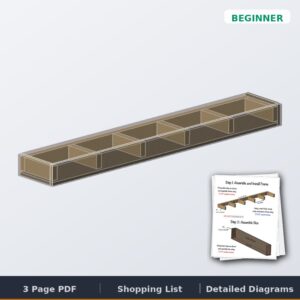
This free floating shelf calculator sizes our hidden-frame floating shelf design to any wall: enter your shelf length, pick a depth, and get the rib layout, a complete cut list, board-by-board cutting layouts with a numbered cut order, and a lumber shopping list — for as many shelves as you’re building. No account, no email wall to use it. It’s the same construction as our free floating shelf plans, built with Shanty2Chic — a hidden 2×4 cleat frame lag-screwed into the studs, with a knot-free pine box that slides over it.
Floating Shelf Calculator
Size this shelf to your wall: enter a length and depth and get the hidden-frame rib layout, a full cut list, and a lumber shopping list — for as many shelves as you’re building.
Your shelf
Your cut list
| Part | Qty | Cut length | Stock |
|---|
📩 Email me my cut list
Get this exact cut list and shopping list for 73″ × 12″ shelves sent to your inbox, with the build guide — free.
Want one with a secret?
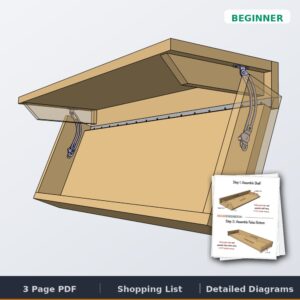
The Secret Floating Shelf (hidden storage) looks identical — but the front drops open to a hidden compartment.
Affiliate links above may earn this site a small commission at no extra cost to you. Tool by Rogue Engineer — measurements match our free floating shelf plans.
How the floating shelf calculator works
The design has two parts, and the calculator sizes both. The hidden frame is a 2×4 rail cut 1½″ shorter than your shelf, with 2×4 ribs coming off it every 14″ or less — never fewer than three, always one near each end. The box is the part you see: full-width 1× boards for the top and bottom, 1×6 ends, and a single uncut 1×6 face, fixed at 5½″ tall. Change the length or depth and every cut updates instantly.
Depth follows real lumber sizes instead of made-up numbers. A 1×6 top builds a 6¼″-deep shelf for frames and display, a 1×8 gives you 8″, a 1×10 gives 10″, and a 1×12 builds the 12″ bookshelf depth of the original — in every case the actual board width plus the ¾″ face. That means every cut in the plan is a crosscut from a full-width board: no rip cuts, no table saw required. A miter saw and a pocket-hole jig build this entire project.
Your boards, laid out cut by cut
Below the cut list, the calculator draws every 8-foot board you’ll buy with your cuts nested onto it — planned by our free Cut List Optimizer with an ⅛″ saw kerf between cuts — plus a numbered crosscut order you can follow at the miter saw. The shopping list comes from the same layout, so the board count is the number that actually survives contact with the saw, not a square-footage guess.
Want to tweak it? One click sends your exact parts into the full optimizer, where you can add parts from another project, switch to 10- or 12-foot boards, print cut sheets, or run part labels.
Hanging it: the part that actually matters
A floating shelf is only as strong as its connection to the wall. The calculator’s stud check estimates how many studs your rail crosses at 16″ spacing — screw the rail into every one with 3½″ screws. The rail carries the weight; the drywall never should. Anchored that way, this design comfortably holds books, dishes, and everything else a shelf this size gets asked to hold.
The full step-by-step — frame assembly, box construction, and how the box slides over the frame — is in the floating shelf build guide, with photos of every step and the finish we used.
Lumber for common floating shelf sizes
Quick reference for one 12″-deep shelf at common lengths, using the calculator’s exact packing math (8-foot boards, ⅛″ kerf, crosscuts only):
| Shelf length | Ribs | 1×12 boards | 1×6 boards | 2×4 boards |
|---|---|---|---|---|
| 36″ | 3 | (1) 1×12 @ 8 ft | (1) 1×6 @ 8 ft | (1) 2×4 @ 8 ft |
| 48″ | 4 | (1) 1×12 @ 8 ft | (1) 1×6 @ 8 ft | (1) 2×4 @ 8 ft |
| 60″ | 5 | (2) 1×12 @ 8 ft | (1) 1×6 @ 8 ft | (2) 2×4 @ 8 ft |
| 73″ | 6 | (2) 1×12 @ 8 ft | (1) 1×6 @ 8 ft | (2) 2×4 @ 8 ft |
| 96″ | 7 | (2) 1×12 @ 8 ft | (2) 1×6 @ 8 ft | (2) 2×4 @ 8 ft |
A different depth or a wall of shelves changes the packing — that’s what the calculator above is for.
Floating shelf calculator FAQ
What lumber do I need for a DIY floating shelf?
Two kinds: 2×4s for the hidden wall frame (the rail and ribs), and 1× pine boards for the box you see — 1×6 for the ends and face, plus 1×6, 1×8, 1×10, or 1×12 for the top and bottom depending on the depth you pick. The calculator turns that into an exact shopping list of 8-foot boards for your size.
How does the calculator decide how many boards to buy?
It packs your actual cut lengths into 8-foot boards with an ⅛-inch saw kerf between cuts, longest pieces first — the same first-fit method a careful builder uses at the lumber rack. Every cut is a crosscut from a full-width board, so there are no rip cuts anywhere in the plan.
How far apart should the support ribs be?
No more than about 14 inches apart, with a rib near each end. The calculator spaces them evenly for your length and never uses fewer than three. The ribs support the box — the rail into the studs is what carries the weight.
How long can a floating shelf be?
This design works from 24 to 96 inches — the one-board limit, since the face is a single uncut 1×6. For a longer wall, build two shelves and run them end to end; the calculator’s multi-shelf option prices the whole set at once.
Does the shelf depth change the cut list?
Yes. The depth options follow nominal 1× stock: a 1×6 top makes a 6¼-inch shelf, 1×8 makes 8 inches, 1×10 makes 10, and 1×12 makes 12 — that’s the actual board width plus the ¾-inch face. The rib length adjusts automatically so the box always slides over the frame.
Can I see exactly how to cut each board?
Yes — the calculator draws every board with your cuts laid out on it and a numbered crosscut order, planned by our free cut list optimizer. One click opens the same list in the optimizer if you want to edit parts, change stock lengths, or print labels.
From calculator to weekend build
Run your numbers, email yourself the cut list, and you’re one lumber run from shelves on the wall. If you want the version with a trick up its sleeve, the Secret Floating Shelf plan looks identical to this one — but the face drops open to a hidden compartment. And credit where it’s due: the original build was a collaboration with Shanty2Chic, whose version of these shelves has lived on our walls ever since.