

This free raised garden bed soil calculator tells you exactly how much soil to buy — in cubic feet, cubic yards, and bags — plus a free custom cut list to build the bed itself, the same way I built ours. Soil is the first place a raised bed project goes sideways: bags are sold in cubic feet, bulk soil is sold in cubic yards, and your bed is measured in feet and inches. Enter your bed size below and the conversions are done for you.
Enter your bed size and get exactly how much soil to buy — cubic feet, cubic yards, and bags — plus a custom cut list to build the bed at your dimensions, the same way I built ours. No sign-up needed to see your results.
A common fill is roughly ⅓ topsoil, ⅓ compost, ⅓ garden soil. Bulk soil is sold by the cubic yard (27 cu ft).
Your custom cut list — for 12' × 4' × 18½", ×1
| Part | Qty | Length | Material |
|---|---|---|---|
| Long wall boards | 4 | 12' | 2×10 board |
| End wall boards | 4 | 4' | 2×10 board |
| Corner posts | 4 | 2' 6½" | 4×4 post |
| Anti-bow cleats | 2 | 1' 6½" | 2×4 |
Corners are staggered ("pinwheel") — every board is cut to the full stated dimension and overhangs its corner post so the next wall butts into it. That means a 12 ft bed uses full 12 ft boards with zero cutting; the finished outside dimension runs about 1½" larger each way. Posts run 12" longer than the bed height to anchor into the ground. Line the inside walls with plastic sheeting before filling.
📩 Email me my cut list + build guide
Get this exact cut list and soil order for 12' × 4' × 18½" sent to your inbox, with the full step-by-step build guide — free.
Common questions
How much soil does a 4×8 raised bed need?
A 4×8 bed about a foot deep (two rows of 2×6 boards = 11″ walls) filled to ~90% needs about 26 cubic feet of soil — roughly 18 bags at 1.5 cu ft, or about 1 cubic yard of bulk soil. Use the calculator above for your exact size.
How much soil for a 12×4 raised bed?
With two rows of 2×10 boards (18½″ walls, the way I built ours) and ~90% full, a 12×4 bed takes about 67 cubic feet — around 45 bags, or 2.5 cubic yards. At that volume, bulk delivery beats bags on price every time.
Is pressure-treated wood safe for vegetable gardens?
Modern pressure-treated lumber (copper-based, not the old arsenic formulas) is rated safe for raised vegetable beds, and it's what I used on ours. If you want extra separation, staple plastic sheeting to the inside walls — it also protects the wood and keeps soil from seeping through the cracks. Cedar is a great option too if the price is reasonable where you live.
Do I need to line the bed?
Line the inside walls with plastic and put weed barrier under the bed, but leave the bottom open to the ground for drainage. Don't wrap the bottom in plastic — the bed needs to drain.
Note: Soil and lumber figures are planning estimates using actual (not nominal) board dimensions. Confirm quantities before purchasing.
A free tool from Rogue Engineer. Be safe and happy building.
How the raised garden bed soil calculator works
A raised bed is just a box, so the formula is simple:
Soil (cu ft) = Length (ft) × Width (ft) × Depth (ft)
Divide cubic feet by 27 to get cubic yards (that’s how bulk soil is sold), or by 1.5 to get the standard bag count.
Two things trip people up, and they’re why this calculator exists:
- Board sizes aren’t what they say they are. A bed built from two rows of 2×10s isn’t 20 inches deep — a 2×10 is actually 9¼″ wide, so the real wall height is 18½″. The calculator uses actual lumber dimensions, so the soil number matches the bed you’ll really build.
- You don’t fill to the brim. Leaving the top couple inches empty keeps soil and mulch from washing over the edge when you water. The calculator defaults to 90% full, and you can adjust it.
How much soil for common raised bed sizes
Quick reference for the most common sizes, filled to 90% (the calculator default), using actual board heights:
Beds 11″ deep — two rows of 2×6
| Bed size | Cubic feet | Cubic yards | 1.5 cu ft bags |
|---|---|---|---|
| 3×6 | 14.8 | 0.55 | 10 |
| 4×4 | 13.2 | 0.49 | 9 |
| 4×8 | 26.4 | 0.98 | 18 |
| 4×10 | 33.0 | 1.22 | 22 |
| 12×4 | 39.6 | 1.47 | 27 |
Beds 18½″ deep — two rows of 2×10 (how I built ours)
| Bed size | Cubic feet | Cubic yards | 1.5 cu ft bags |
|---|---|---|---|
| 3×6 | 25.0 | 0.93 | 17 |
| 4×4 | 22.2 | 0.82 | 15 |
| 4×8 | 44.4 | 1.64 | 30 |
| 4×10 | 55.5 | 2.06 | 38 |
| 12×4 | 66.6 | 2.47 | 45 |
Your bed a different size? That’s what the raised garden bed soil calculator above is for. The starred row is the exact size we built.
What should you fill it with?
A mix that’s served our garden well: roughly ⅓ topsoil, ⅓ compost, ⅓ garden soil. The topsoil is cheap volume, the compost feeds the plants, and the bagged garden soil keeps the texture loose enough to drain. If you want to stop buying the compost third altogether, I built a double compost bin that keeps our beds fed — free plans on that post.
Bags or bulk? Once you’re past about 15 cubic feet, bulk soil by the cubic yard is usually much cheaper than bags — a single 4×8 bed at 18½″ deep already needs 30 bags, and hauling 30 bags is its own workout. Bulk is sold by the cubic yard (27 cu ft); most landscape yards deliver.
One warning from experience: don’t fill a tall bed entirely with expensive soil. For beds 18″ and up, the bottom third can be old logs, branches, and leaves — a trick borrowed from hügelkultur — which saves real money and breaks down into compost over time.
Building the bed too?
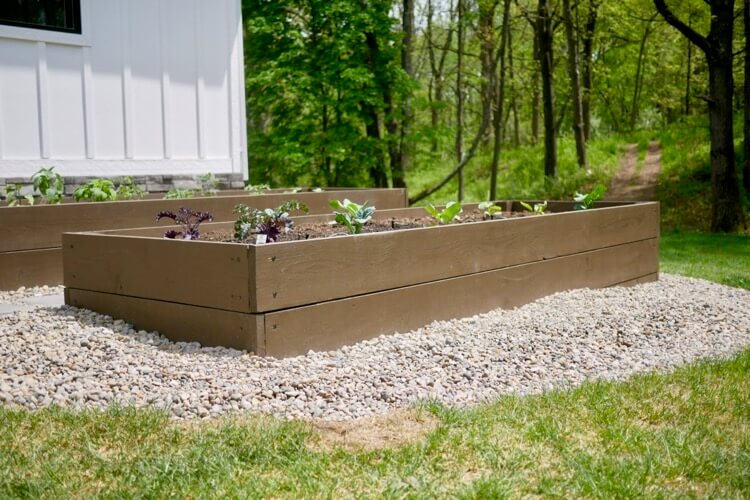
The cut list the calculator gives you isn’t generic — it’s sized to your dimensions using the exact construction we used for our beds: 2× lumber walls, 4×4 corner posts anchored a foot into the ground, and pinwheeled corners lag-bolted together so the walls can’t bow apart.
The full step-by-step build — photos, the irrigation setup, and everything I’d do differently — is here: How to Build a Raised Garden Bed and the raised beds with automated irrigation version we run today. And if deer or rabbits treat your garden like a buffet, the welded wire garden fence we put around ours has kept them out for years.
If you want the whole thing worked out for you, the plan is coming soon — the “email me my cut list” button above will get you everything for your size in the meantime.
Be safe and happy building.
— Jamison